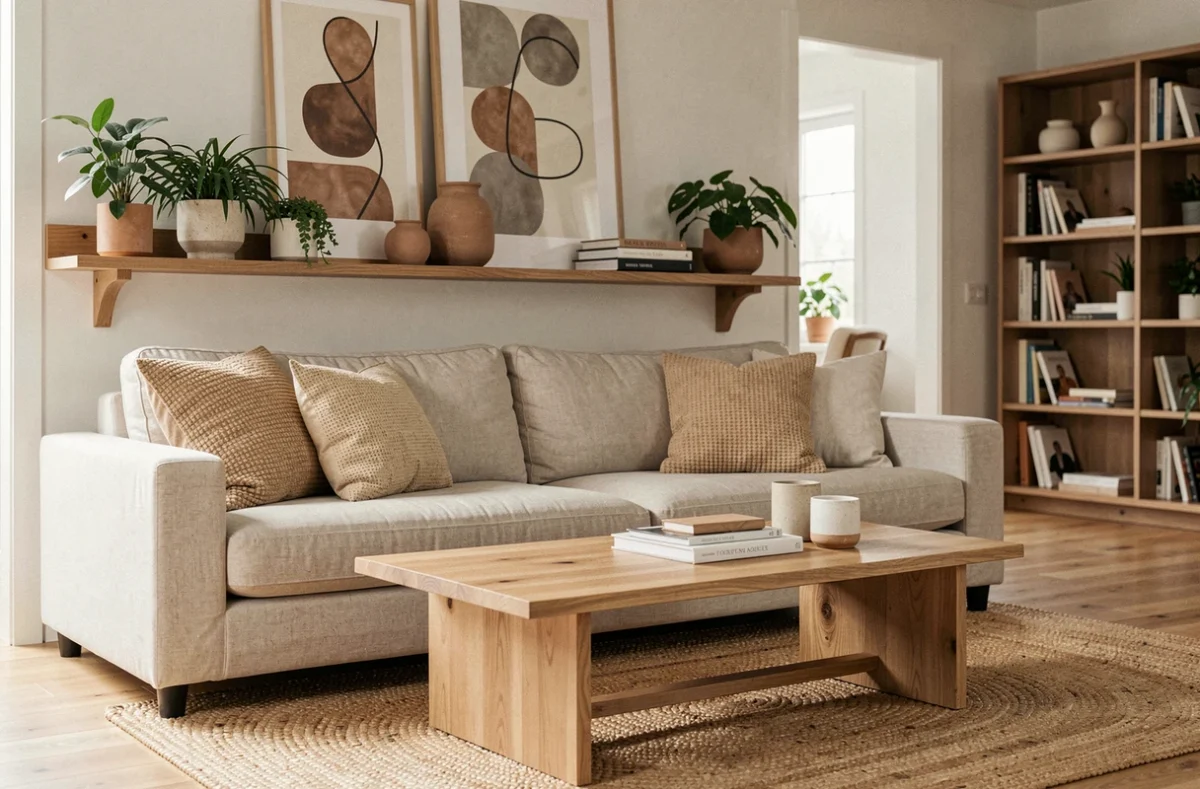
Changing the atmosphere of a room doesn’t always require major renovations. A well-chosen textile, a freshly painted wall or a vintage find can be enough to give a space character. Here are 15 practical decorating ideas to transform your home with style and personality, with choices that feel true to you.
1. Low-VOC accent wall
Painting a single wall in a bold colour can transform the feel of an entire room. Terracotta, sage green, midnight blue: the shade sets the mood without changing the furniture.
Before choosing a colour, check the paint’s emissions. The revised criteria for the EU Ecolabel for paints and varnishes, adopted by Decision (EU) 2025/2607, cover volatile organic compounds (VOCs). Compare emissions before choosing a shade to protect indoor air quality, especially in bedrooms and poorly ventilated rooms.
An accent wall works best opposite the room’s entrance or behind a sofa. Avoid painting the wall with the main window: natural light softens the contrast you’re trying to create.
2. Restored second-hand furniture
A vintage 1960s sideboard or a well-worn club chair brings a personality that no new piece of furniture can replicate. Browse Déco en Vogue’s decorating ideas for inspiration on pairing vintage pieces with contemporary objects without clashing styles.
France’s furniture sector is governed by extended producer responsibility. Its 2024–2029 framework strengthens targets for repair and reuse. Reuse centres and specialist retailers offer restored furniture with better quality control than a typical flea market.
Keep in mind that a material’s appearance alone doesn’t prove it is structurally sound, especially when it comes to salvaged materials such as load-bearing elements and finishes. Ask for technical documentation where available.
3. Gallery wall of framed art
A gallery wall is a collection of frames in different sizes and styles arranged together on one surface. It works well in a hallway, above a sofa or along a staircase.
The simplest rule: lay all your frames on the floor, try out a few arrangements, then recreate your chosen layout on the wall. Mix personal photos, illustrations and small framed objects. A gallery wall tells a personal story—it’s not a catalogue.
4. Layered textiles in the living room
Cushions, throws and rugs can make a space feel warmer in minutes. Layering different textures—linen, bouclé wool and corduroy, for example—adds visual depth that colour alone can’t achieve.
Ever noticed how a grey sofa can look dull without accessories? Add two cushions in complementary shades and a throw in a natural fabric. The living room takes on a whole new feel without buying any furniture.
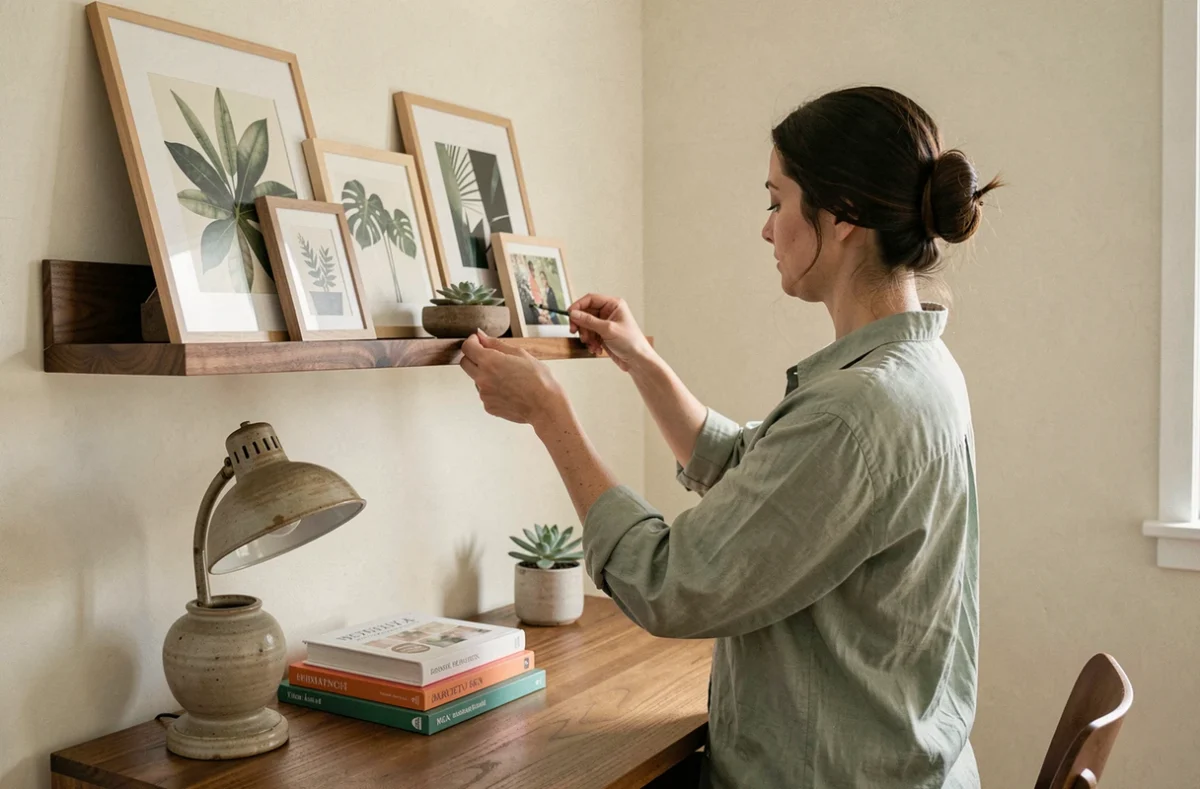
5. Open shelves in unfinished wood
Replacing a closed cabinet with open solid-wood shelves makes a room feel lighter. In the kitchen, they display crockery. In the living room, they hold books, plants and decorative objects.
One pitfall to avoid: clutter. Fill no more than about two-thirds of the available space. Alternate tall and short objects, and leave some breathing room between groups. A thoughtfully styled open shelf beats an overfilled bookcase.
6. Accent lighting at different heights
A single ceiling light creates flat lighting. Adding multiple light sources—a table lamp, floor lamp and wall light—at different heights creates distinct moods within the same room.
Choose warm-toned bulbs for the living room and bedroom. A dimmer lets you switch from practical lighting to a softer ambience without changing the bulb. Lighting is one of the most overlooked decorating tools.
7. Group houseplants in threes
A plant on its own can go unnoticed. Group three plants of different heights together to create a natural focal point. Monstera, ficus and pothos are easy to care for and suit most interiors.
Mix up the containers: a terracotta planter, a woven basket and a concrete pot. The contrast in materials enhances the decorative effect just as much as the foliage itself.
8. Large mirror to make a room feel bigger
A large mirror leaning against a wall or hung opposite a window reflects more natural light. In a narrow entryway or studio apartment, it makes the space feel bigger without any renovations.
Position the mirror opposite the main light source to maximise the reflection. A weathered wood or black metal frame adds character, while a slim frame blends in for a more streamlined look.
9. Graphic rug to define different areas
In an open-plan space, a rug visually defines the living area, dining area or reading nook. Choose a rug that extends beyond the furniture it anchors: at a minimum, the sofa’s front legs should rest on it.
Geometric patterns or stripes add structure to a room with neutral flooring. A solid-colour textured rug works better if your walls are already busy.
10. Handmade ceramic pieces
A hand-thrown vase, an irregular bowl or a glazed dish: handmade ceramics bring a deliberate imperfection that breaks up the showroom look. Each piece is unique, making your decor feel more personal.
Group two or three ceramics in similar shades on a tray or console table. Handmade objects look best in small groupings rather than scattered around the room.
11. Panoramic wallpaper on one wall
Panoramic wallpaper—a landscape, botanical design or abstract mural—can replace a painting and transform a room in one simple step. Applying it to just one wall keeps the look from feeling overwhelming.
Non-woven wallpaper is easier to hang and can be removed without damaging the surface, making it a good choice for renters. Choose a pattern scaled to the size of the wall: a design that’s too small will lose its impact on a large wall.
12. Wall storage with cane webbing
Cane webbing has been making a comeback in home decor for several years. Used on cupboard doors, headboards or wall hooks, it adds warmth and a light, airy texture.
Why choose it over conventional storage? Cane webbing lets light through and makes bulky furniture look lighter. It pairs just as well with pale Scandinavian-style wood as with an industrial-style black metal frame.
13. Window-seat bench with cushions
If you have a low window or alcove, a built-in bench creates a reading nook or a place to relax without taking up floor space. A storage compartment beneath the seat provides hidden storage.
Add cushions in durable fabrics such as heavyweight cotton or washed linen, in colours that echo the rest of the room. This kind of built-in seating makes the most of otherwise wasted space beneath windows or in alcoves.
14. Add colour to woodwork and doors
Painting skirting boards, door frames or mouldings in a contrasting colour can redefine a room’s architecture. Deep green against white woodwork or slate blue on a door frame: the effect is striking and inexpensive.
This approach works especially well in older apartments, where the mouldings are already in place. It adds depth without introducing any extra objects.
15. Decorative tray on the coffee table
A wooden, marble or brass tray on a coffee table helps organise the space and group small items such as candles, books and dishes. Without a tray, these items can look cluttered.
Style the tray with three types of objects: something tall (a candle or small vase), something flat (a book or coaster) and something organic (a stone or small plant). This simple rule keeps things tidy while still looking lived-in.
- Choose a tray no larger than half the surface area of the coffee table.
- Mix materials between the tray and the objects on it to create contrast.
- Refresh the contents with the seasons to update your decor without buying anything new.
Transforming a home often comes down to a few thoughtful touches rather than a complete makeover. A wall painted with low-emission paint, a restored piece of furniture from a reuse centre, carefully layered textiles: every choice reflects a way of life. A home’s personality is built through an accumulation of meaningful details, not by following a predefined style.