A casserole coming out of the oven at 7:45 PM with three hungry children in the kitchen is the kind of situation where the recipe needs to be concise. We’re talking about practical family dishes designed to be adapted from one night to the next, taking into account a constraint that most cooking blogs overlook: managing allergens at home.
Cross-contamination in family kitchens: the trap of shared indulgent recipes
When cooking for the whole family and one member has allergies, the problem doesn’t always stem from the main ingredient. It comes from the countertop, the wooden spoon that touched the pancake batter before stirring the sauce, or the reused frying oil after cooking breaded donuts.
The association Allergie France recommends to first prepare the meal without the allergen, then follow up with the classic version. Simply cleaning the utensils between the two uses isn’t always enough: a dedicated frying oil is sometimes necessary to avoid any cross-contamination.
In France, decree no. 2015-447 of April 17, 2015, mandates written and accessible information on allergens for non-prepackaged food items. If you are preparing cakes or dishes for a school sale, a fair, or a community market, this obligation directly concerns you. You can find recipes on papillesheureuses.fr that facilitate this type of adaptation in daily life.
In practice, this means clearly labeling each dish brought, even a simple savory cake. Wheat flour, eggs, milk, nuts: the list of fourteen allergens that must be declared also applies to home preparations as soon as they leave the family circle.
Reusable base family recipes: cook once, eat three times
Batch cooking is nothing new, but its principle remains underutilized in busy households. The idea is not to spend the entire Sunday in the kitchen. It’s to prepare two or three neutral bases that can be adapted for several meals.
A homemade tomato sauce as the week’s foundation
Start by sautéing onion in a drizzle of olive oil, add crushed tomatoes, a pinch of salt, and basil. This sauce serves Monday night over pasta, Tuesday in a vegetable gratin with grated cheese, and Wednesday as a base for homemade pizza with the kids.
The benefit is not just in time. It’s also a lever to reduce reliance on industrial dishes and better control what the family eats, especially in terms of salt and added sugars.
A roast chicken that feeds well beyond Sunday
The weekend roast chicken leaves usable leftovers: shredded in a wrap with yogurt sauce on Monday, mixed with rice and sautéed vegetables on Tuesday. You get three distinct meals from a single cooking, without anyone feeling like they’re eating the same thing.
- Homemade tomato sauce: base for pasta, vegetable gratin with cheese, quick pizza
- Roast chicken: Sunday dish, Monday wraps, Tuesday fried rice
- Mashed potatoes: classic side, filling for shepherd’s pie, base for pan-fried croquettes
- Ratatouille: as a hot side, as a cold filling in a quiche, or blended into a sauce for a vegetarian pasta dish
Vegetarian family meals: going beyond pasta gratin
It’s often said that children don’t eat vegetarian. Feedback varies on this point, but the issue lies less in the principle than in the execution. A bland zucchini gratin won’t convince anyone. A spiced red lentil dhal with cumin, served with rice and a drizzle of lemon, is much more likely to be accepted.
Family vegetarian meals work when the recipe has flavor and texture. A crispy chickpea patty, a sweet potato curry with coconut milk, a savory leek and goat cheese tart: these are complete dishes that are satisfying.
For dinner, a thick butternut or broccoli soup with golden croutons drizzled with olive oil is a great alternative to boxed soup. Cooking takes about twenty minutes, and an immersion blender is all you need.

Cooking with children: which steps to delegate safely
Involving children is not a pedagogical gimmick. It’s a concrete way to free up time on certain tasks while getting them to accept dishes they would otherwise refuse. A child who has grated cheese or mixed batter is more likely to taste the result.
The steps to delegate depend on age:
- From three years: washing vegetables, picking herbs, mixing cake batter in a stable bowl
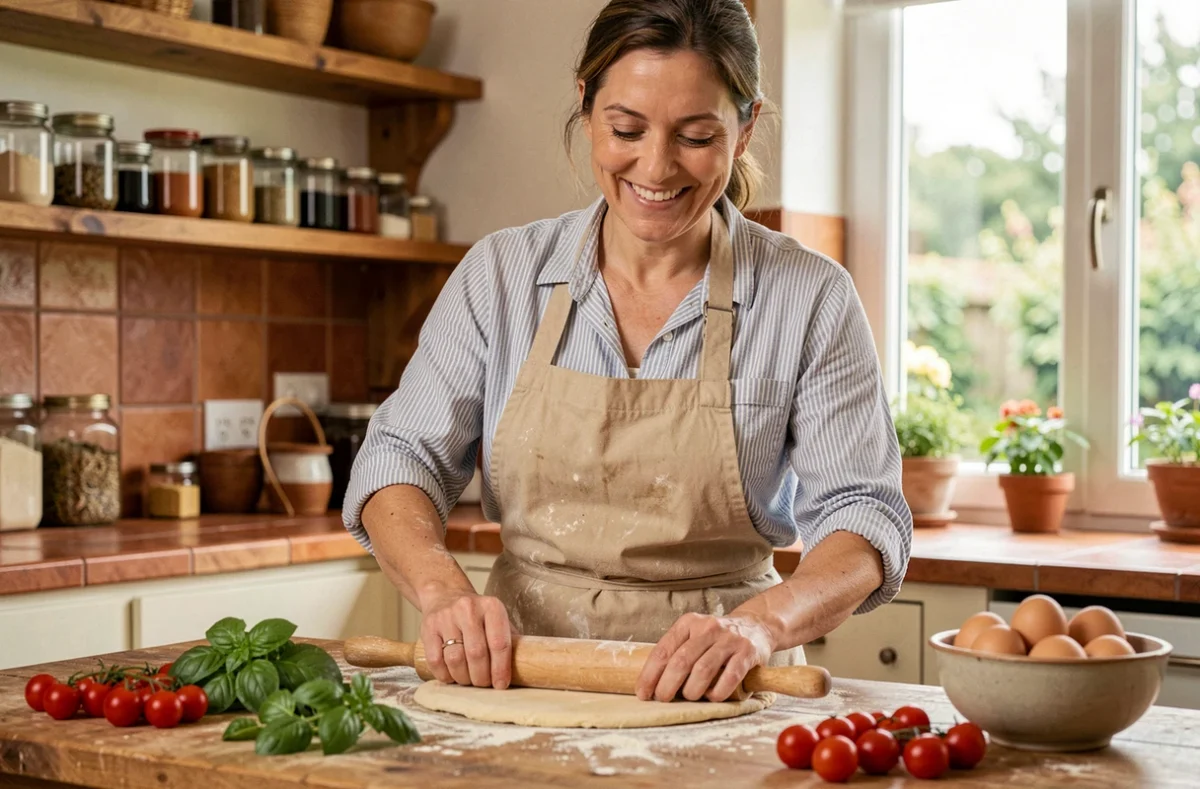
- Around six years: cracking eggs, measuring ingredients with a measuring cup, rolling out pastry
- From eight to nine years: peeling with a suitable peeler, monitoring gentle cooking under supervision, cutting soft vegetables with a rounded knife
The key is to choose recipes with few critical steps. A savory cake, cookies, a composed salad: these preparations tolerate imprecision and allow for improvisation without compromising the result.
Adapting recipes for modified textures: a forgotten family angle
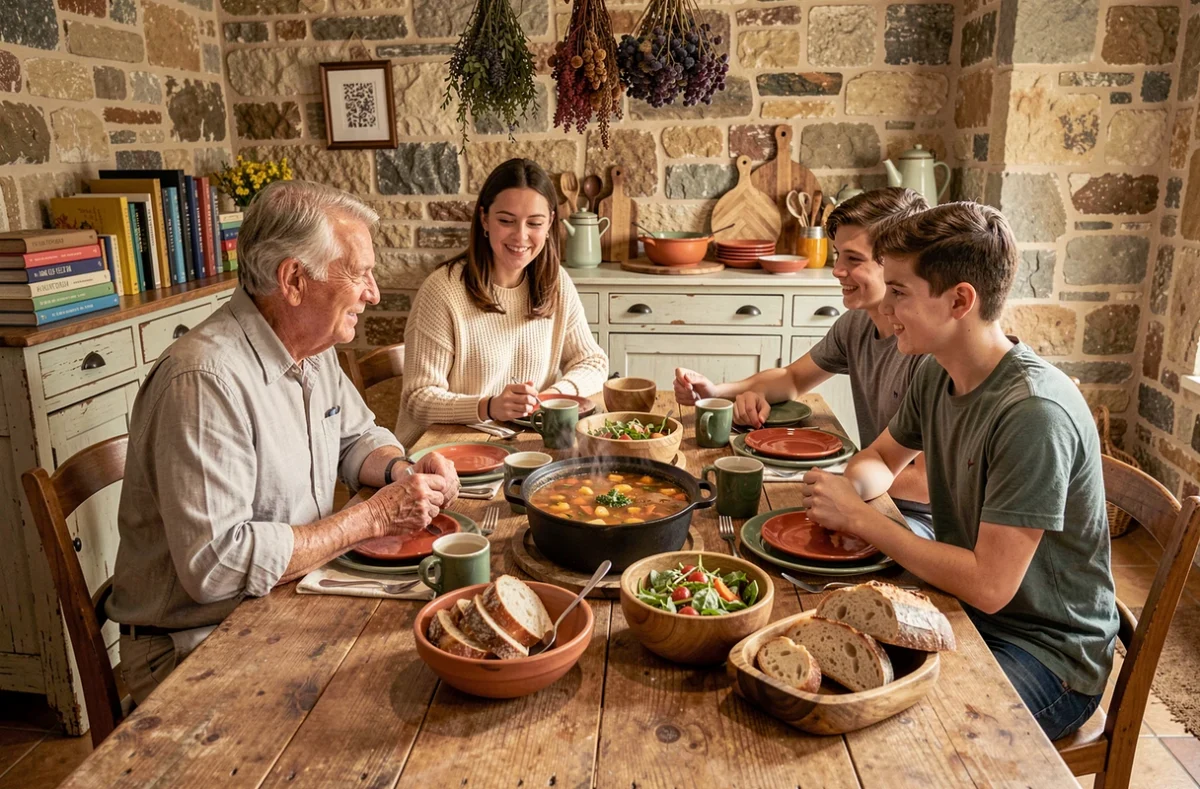
In some families, a grandparent or relative needs a modified texture diet, whether it be pureed, chopped, or smooth. You can cook a single meal and adapt the texture at serving time rather than preparing two separate menus.
A pot-au-feu, for example, lends itself perfectly to this approach. The long-cooked vegetables and meat can be easily blended into individual portions while the rest of the table enjoys the dish as is. A single meal with two textures avoids isolation at the table.
Soups, gratins, stews, and homemade applesauce work on the same principle. The goal is not to create a separate medical menu but to integrate this constraint into the common family meal.
Thinking of your indulgent recipes as modular bases is ultimately what distinguishes sustainable family cooking from a collection of isolated dishes. The same gratin, the same sauce, the same chicken can nourish the entire table, regardless of ages, diets, or necessary textures.